
2026 / 07 / 08 Ernie Mota
What Is GEO? Generative Engine Optimization, Explained for Local Business Owners
Here's the shift in one before-and-after.
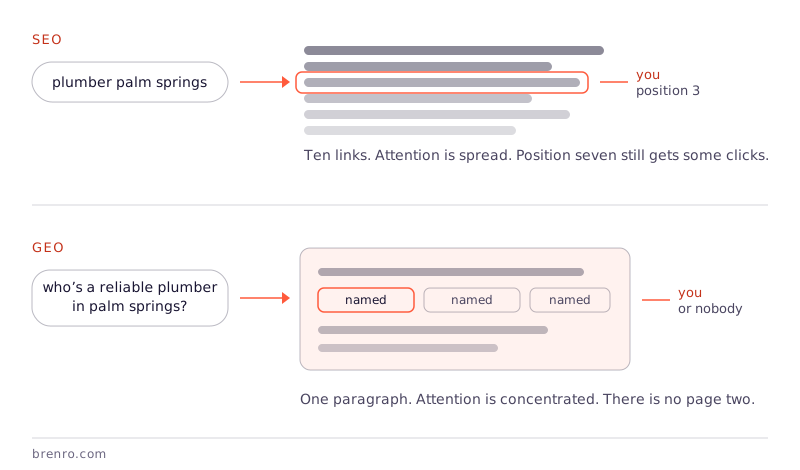
Before: a customer typed "plumber palm springs" into Google and got ten blue links. Your job was to be one of the top links. That job was called SEO, and an entire industry grew up around it.
After: that same customer asks ChatGPT, or Perplexity, or just talks to their phone: "Who's a reliable plumber in Palm Springs? I have a slab leak and two bad reviews scare me." And instead of ten links, they get a paragraph. Three businesses, named, with reasons. A recommendation, not a results page.
Your new job is to be in the paragraph. That job is called GEO: Generative Engine Optimization, and it is genuinely different work from SEO, even though the two overlap.
Why a paragraph changes everything
A results page distributes attention. Even position seven on Google got some clicks. A generated answer concentrates it: the two or three businesses named get everything, and everyone else gets nothing at all. There's no page two of a paragraph.
That makes this moment unusually high-stakes for local businesses, and unusually opportunity-rich, because most of your competitors haven't noticed it's happening. When we ran AI visibility checks across Coachella Valley businesses this spring, the pattern was stark: the businesses being recommended by AI weren't reliably the biggest, the oldest, or even the best-reviewed. They were the best documented, the ones whose websites and profiles actually answer questions in complete sentences.
How AI decides who to recommend
Nobody outside these companies knows the exact recipe, but the ingredients are visible, and they're consistent across ChatGPT, Perplexity, Gemini, and Google's AI Overviews:
Answerable content. These systems build answers out of text that already reads like an answer. A page that says "A typical water heater replacement in the Coachella Valley runs $1,800–$3,200 installed, and here's what changes the price" can be quoted. "We're your trusted plumbing experts!" cannot. Vague websites are invisible websites now.
Consistent facts. Your name, address, phone, and hours across Google, Yelp, Apple Maps, and the local directories. When the facts about you disagree with each other, AI systems hedge, and hedging means recommending someone else.
Structured data. Machine-readable code on your site that declares what you are, what you offer, and answers to common questions. Customers never see it. The machines writing the paragraphs read little else first.
Third-party evidence. Reviews, mentions in local press, chamber listings, community pages. AI trusts what others say about you more than what you say about you, same as people, honestly.
AI access. Some websites accidentally block AI crawlers entirely, or bury their content in ways machines can't parse. There's even an emerging standard, a file called llms.txt, for telling AI systems what your site contains. Almost no local business has one. Ours does, though we'd tell you honestly that no major AI system reads it yet.
The same five signals, side by side:
| Signal | Working | Broken |
|---|---|---|
| Answerable content | "A water heater replacement here runs $1,800 to $3,200 installed, and here's what moves the price" | "We're your trusted plumbing experts!" |
| Consistent facts | Same name, address, phone and hours on Google, Yelp, Apple Maps, directories | Listings that disagree, so the AI hedges and names someone else |
| Structured data | Machine-readable code declaring what you are, what you offer, what you answer | Nothing to read, so the machine guesses from your prose |
| Third-party evidence | Reviews, local press, chamber listings, community pages | Only your own site vouching for you |
| AI access | Crawlers allowed, content in plain server-rendered HTML | Blocked bots, or text that only appears after JavaScript runs |
Is SEO dead, then?
No, and be suspicious of anyone selling either extreme. Some agencies are telling clients AI is a fad and classic SEO is all that matters, there are shops taking that position right here in the valley. Others will sell you "AI optimization" as if Google stopped existing. Both are selling their comfort zone.
The truth is more useful: GEO is built on an SEO foundation. Clean listings, real content, solid technical structure, that work pays in both worlds. GEO adds a layer on top: writing so machines can quote you, structuring data so machines can trust you, and measuring whether the AI tools actually name you when it counts.
That last part is the new discipline. You can't manage what you don't measure, and almost no local business has ever once checked what ChatGPT says about them. It takes ten minutes and it's frequently horrifying. It's also the first thing we do in every engagement, because your before picture is where the plan starts.
The window here is real. Being early to SEO in 2005 built businesses that coasted for a decade. Being early to GEO in your local market is the same bet at better odds, because this time, you can literally read the answer and see nobody from your town is in it yet.
Questions we get about GEO
Is GEO just SEO with a new name? No, but it's not a replacement either. Roughly, SEO earns you a ranking; GEO earns you a citation. The foundations overlap heavily, which is why doing GEO well quietly improves your Google rankings too. Think of it as SEO's second job, not its funeral.
How do I check my own AI visibility right now? Ask ChatGPT, Perplexity, and Google (with AI Overviews on) the questions your customers would ask: "best [your trade] in [your city]," plus a couple of specific, situational ones. Note who's named, who's not, and what the AI says about you if it mentions you at all. Screenshot it. That's your baseline.
How long does GEO take to show results? Often faster than traditional SEO, especially in smaller markets. AI systems refresh their view of the web constantly, and in most local niches you're competing against nobody. We've seen businesses go from unmentioned to cited within weeks of publishing answerable content and fixing their structured data.
Can a business rank well on Google and still be invisible to AI? Absolutely, and it's common. Ranking is earned partly through signals AI doesn't weigh the same way. If your site ranks but says nothing quotable, AI has nothing to work with. That mismatch is exactly what an AI visibility audit is designed to find.