
2026 / 07 / 10 Ernie Mota
llms.txt, Schema, and Entities: The Technical Checklist for AI Search Visibility
The last two posts covered why AI visibility matters. This one is the how, specifically the technical layer, because that's where most local business websites fail silently. Your site can look beautiful to a human and be nearly unreadable to the systems now deciding who gets recommended.
This is the checklist we run on every site we build or audit. It's not secret. Most of your competitors won't do it anyway.
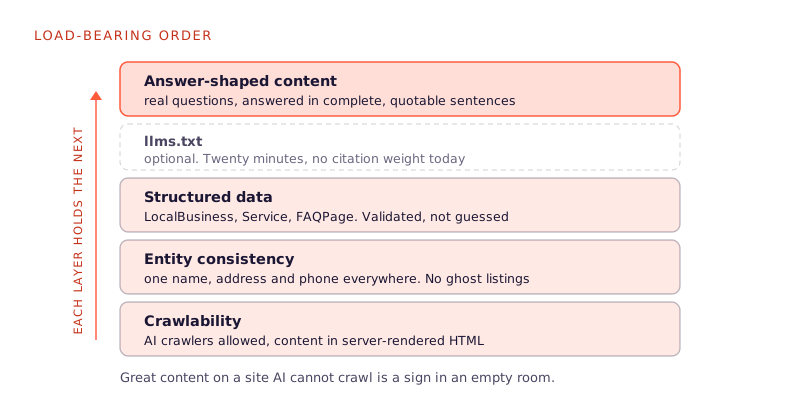
| # | Layer | What it does | Needs a developer? |
|---|---|---|---|
| 1 | Structured data | Declares your facts in a format machines parse instead of guess | Sometimes. Plugins cover the basics, correctness is the paid part |
| 2 | llms.txt | Nothing measurable today. Twenty minutes of optionality | No, it is a text file |
| 3 | Entity consistency | Stops your own listings contradicting each other | No, just a spreadsheet and patience |
| 4 | Crawlability | Lets AI systems read the page at all | Sometimes, if the site renders in JavaScript |
| 5 | Answer-shaped content | Gives them something worth quoting once they can read it | No. This one is on you |
1. Structured data (schema markup)
Schema is code, usually JSON-LD in your page's head, that states facts about your business in a format machines parse directly instead of guessing from your prose. For a local business, the minimum viable stack is:
LocalBusiness (or a specific subtype like AutoRepair, Dentist, Plumber): name, address, phone, geo-coordinates, hours, price range, and the areas you serve. This is the machine-readable version of your identity, and it should match your Google Business Profile exactly, same spelling, same suite number, same phone format.
Service markup for each core service you offer, each on its own page. One page that lists everything you do is one page competing for everything and winning nothing.
FAQPage markup wherever you answer real questions. This one punches far above its weight for AI visibility, because you're literally handing the machine pre-formatted question-and-answer pairs, the exact shape of the content it's trying to generate.
Organization markup that ties your site to your other presences: GBP, social profiles, directory listings. The sameAs property is how you tell machines "these scattered profiles are all one entity."
Validate all of it at validator.schema.org. Broken schema is worse than none, it signals carelessness to systems built to detect exactly that.
2. llms.txt
robots.txt has told search crawlers how to behave since the nineties. llms.txt is its newer sibling: a plain-markdown file at yoursite.com/llms.txt that gives AI systems a curated map of your site, what you are, what your key pages contain, what's worth reading first.
Is it a guaranteed ranking factor? No, and here the honest answer is stronger than the sales pitch. Google's John Mueller has said plainly that no AI system currently uses llms.txt, comparing it to meta keywords. Gary Illyes confirmed Google has no plans to support it. A 2025 server-log audit by OtterlyAI found that 0.1% of AI-bot requests target the file, 84 out of 62,100. SE Ranking looked at the 50 most-cited domains in AI answers and found exactly one publishing an llms.txt.
So why do we still ship one on every build? Because it costs twenty minutes, it carries zero risk, and it forces a genuinely useful exercise: writing a one-page, plain-language summary of your business that a machine can ingest whole. That summary tends to sharpen the rest of the site. If a major AI provider does adopt the standard, you are already there. Ours is at brenro.com/llms.txt if you want a live example to steal the format from.
What we won't do is sell it to you as the thing that gets you cited. Anyone who does is either not reading the primary sources or is counting on you not to.
3. Entity consistency
Search engines and AI systems don't really index websites, they model entities: this business, at this place, offering these services, related to these other entities. Your job is to make your entity unambiguous.
That means your NAP (name, address, phone) is character-for-character identical across your site, GBP, Apple Maps, Bing Places, Yelp, and the directories that matter in your area (for us in the valley, that includes the chamber listings). It means one canonical business name, not three variations. It means your About page states plainly what you do and where, in sentences, because entity understanding is built from text, not vibes.
If your business has ever moved, rebranded, or changed numbers, assume ghost listings exist and hunt them down. Conflicting facts don't just fail to help, they actively lower machine confidence in everything else you claim.
4. Crawlability for AI specifically
Check your robots.txt and any firewall rules against the actual AI user agents: GPTBot, ClaudeBot, PerplexityBot, Google-Extended and friends. Plenty of sites block these unknowingly (some security plugins block them by default) and then wonder why they don't exist in AI answers. Blocking AI crawlers is a legitimate choice for a publisher protecting content. For a local business trying to get recommended, it's shooting the messenger.
Also: if your site renders its content entirely through JavaScript, some AI crawlers see a blank page. Server-rendered or static HTML isn't just a performance choice anymore; it's a visibility choice.
5. Answer-shaped content
Technical structure carries content; it doesn't replace it. Every service page needs to answer the questions people actually ask, cost ranges, timelines, process, "how do I know if I need this", in complete, quotable sentences near the top of the page. Marketing copy that could apply to any business in your industry is, to an AI, indistinguishable from silence.
That's the checklist. None of it is glamorous. All of it compounds, and right now, in most local markets, completing this list puts you in roughly the top one percent of AI-ready businesses in your category, because the other ninety-nine percent haven't started.
Questions we get about the technical side
Do I need a developer for this? For schema and llms.txt, mostly no, modern site platforms and plugins can handle basic structured data, and llms.txt is a text file. What you're really paying a professional for is correctness (validated schema, no conflicts) and completeness (Service and FAQPage layers, entity cleanup), which is where DIY implementations usually stop short.
What's the single highest-impact item on this list? For most local businesses: FAQPage schema wrapped around genuinely good answers, sitting on top of a clean LocalBusiness markup. It attacks the visibility problem from both ends, machine-readable structure and quotable content, at once.
How do I know if AI crawlers can see my site? Check your robots.txt for blocks on GPTBot, ClaudeBot, and PerplexityBot, then check your server logs or analytics for visits from those agents. No visits over several weeks usually means a block or a rendering problem worth investigating.
Is llms.txt actually used by AI companies? Not meaningfully, as of today. Google's John Mueller has said no AI system currently uses it, and OtterlyAI's 2025 server-log audit measured 0.1% of AI-bot requests hitting the file (84 of 62,100). We still publish one on every build, because it takes twenty minutes and costs nothing if the standard is adopted later, but it is optionality, not a citation lever. If someone quotes you a price for llms.txt as an AI visibility service, that is the tell.