
2026 / 07 / 02 Ernie Mota
Why Your Auto Repair Shop Doesn't Show Up When People Ask ChatGPT for a Mechanic
Try something. Open ChatGPT and type: "I need a good mechanic near Palm Desert, my AC quit and it's 115 out."
Read the answer. Is your shop in it?
For almost every independent shop I've run this test on, the answer is no. What comes back instead is usually a chain, a dealership service department, or a shop that closed two years ago. Meanwhile, the driver who asked that question is real, their AC is genuinely dead, and it is genuinely 115 out. They're not going to page two of Google. They're not going to Google at all. They asked, they got three names, and they're calling one of them from the Circle K parking lot.
This is happening now, not someday. And the reason your shop isn't in the answer has almost nothing to do with how good your work is.
AI doesn't crawl your reputation. It reads what's written down.
When ChatGPT, Perplexity, or Google's AI Overviews recommend a business, they're assembling an answer from what's publicly written about you: your Google Business Profile, your website's actual text, review content, directory listings, and how consistently your name, address, and phone number appear across all of it.
Here's the problem for most shops. Your reputation lives in places AI can't read, the fleet manager who's sent you every truck for nine years, the customer who tells her neighbors you're the only honest shop in town, the fact that you're the guy other shops send their electrical gremlins to. None of that is written down anywhere. So as far as an AI is concerned, it doesn't exist.
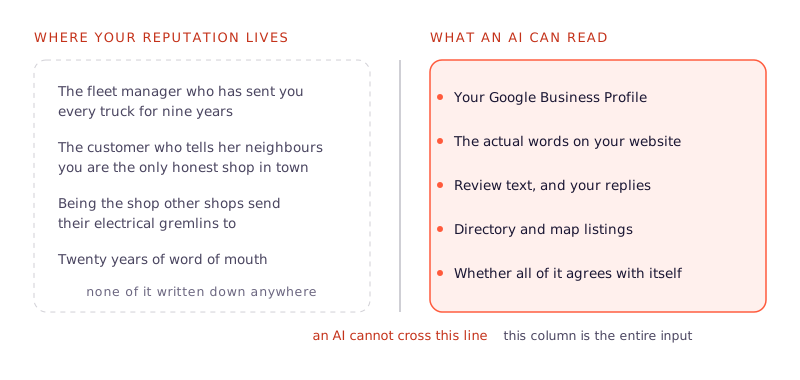
What is written down is often working against you. A website that says "Welcome to our website! We offer quality service at affordable prices" tells an AI nothing. It can't cite that. There's no answer in it.
What actually gets a shop cited
I'll give you the short version, because the long version is a whole audit.
Your site has to answer questions in plain sentences. When someone asks an AI "how much does an AC compressor replacement cost in the desert," the AI looks for a page that answers that question directly. If your site has a page that says, in actual words, what an AC job typically runs, why desert heat kills compressors faster, and what your diagnostic process looks like, you become quotable. Quotable is the whole game.
Your Google Business Profile has to be complete and alive. Categories set correctly (not just "auto repair": AC repair, brake service, diagnostics, fleet service if you do it). Services listed individually. Photos from this year, not from when you painted the bays. Recent reviews with owner responses. AI systems lean on GBP heavily for local answers, and a half-filled profile reads as a half-real business.
Your name, address, and phone have to match everywhere. If Yelp has your old Highway 111 address and your site has the new one, an AI doesn't know which is true, so it trusts you less on everything. Boring work. Matters a lot.
Structured data. This is the technical layer, code on your site that tells machines "this is a business, here are its hours, here are its services, here are its FAQs." Most shop sites have none. It's invisible to customers and load-bearing for AI.
| What to fix | What it looks like done | What most shops have |
|---|---|---|
| Site answers questions | A page saying what an AC job runs here, why desert heat kills compressors, what your diagnostic process is | "Quality service at affordable prices" |
| Profile complete and alive | Categories set properly, services listed one by one, photos from this year, recent reviews with owner replies | Primary category only, photos from the repaint |
| NAP matches everywhere | Same address and phone on site, Yelp, maps, directories | The old Highway 111 address still live somewhere |
| Structured data | Business, hours, services and FAQs declared in code | None at all |
The honest part
None of this replaces being good at the work. It's the opposite: it's finally getting credit for being good at the work in the places where people now ask. The shops winning AI recommendations in the valley right now aren't better mechanics than you. They're just better documented.
That gap is fixable, and right now it's cheap to fix, because almost nobody in the Coachella Valley has done it. In a year, that won't be true.
AI answers are one piece of a bigger picture. For where they fit next to your profile, reviews, website, and ads, see what to do first in auto repair shop marketing.
Questions shop owners ask us about this
Do people really use ChatGPT to find a mechanic? Yes, and the number is climbing fast, especially for "situation" searches like a breakdown, a weird noise before a road trip, or an AC failure in summer. Traditional search still matters, but AI answers are eating the top of the funnel where the urgent, high-ticket jobs start.
Can I just pay to show up in AI answers? Not into the answer itself, though the ground here moved in 2026 and a lot of writing on the subject has not caught up. Google now runs ads above, below and inside AI Overviews, and OpenAI began testing ads in ChatGPT in February 2026, expanding beyond the US since. In both cases the ad is labeled and kept separate from the answer, and OpenAI states that ads "do not influence the answers ChatGPT gives you." So there is a placement to buy next to the recommendation, and still none inside it. Citations are earned from public information, which is bad news if you ignore it and very good news if you're the first shop in your area to take it seriously. (Sources checked August 2026.)
How long does it take to start showing up? Faster than traditional SEO. We've seen shops appear in AI answers within weeks of fixing their profile, adding answer-format content, and cleaning up listings, because the systems re-read the web constantly and there's so little local competition doing this.
Does this help my regular Google ranking too? Almost everything that makes you AI-visible, complete profiles, consistent listings, real answers on your site, is also classic local SEO. You're not choosing between them. It's one body of work that pays twice.