
2026 / 08 / 01 Ernie Mota
The Latest AI Search Research, Checked: What Actually Holds Up
Every week somebody sends me a screenshot of a scary statistic about AI search. Usually it has no date, no source, and no method attached. Usually it sits three sources deep from wherever the number actually came from, and the number changed shape at every hop.
So here is a different kind of post. Four claims that are circulating right now, checked against the original documents rather than somebody's summary of them. I read every source linked below, start to finish. If a study was locked behind something I couldn't read myself, it isn't in this post. Check my work.
| Claim | Verdict | Primary source | Sample |
|---|---|---|---|
| There's a secret AI ranking system to optimize for | False | Google's own AI features documentation | n/a, it is a published spec |
| AI Overviews are killing your clicks | True | Pew Research Center, July 2025 | 68,879 searches by 900 US adults |
| Organic clicks are in freefall | Does not hold up | Seer Interactive, April 2026 | 5.47M queries, 53 brands, 14 months |
| You can't compete with big brands in AI | Half true | Chu & Hou, Incumbent Advantage, June 2026 | ~23,000 API calls, 3 models, 2 languages |
1. "There's a secret AI ranking system you need to optimize for"
False, and the best source on this is Google.
The whole GEO product category rests on an unstated premise: that AI answers run on some separate machinery with its own rules, and you need a specialist to work it. So it's worth reading what Google actually publishes about it. Their documentation on AI features is a public page anyone can read, and as of today it states there are "no additional requirements to appear in AI Overviews or AI Mode", and no special optimizations necessary.
Specifically, per Google: no AI-specific text files. No special markup. No unique structured data beyond ordinary practice. A page needs to be indexed and eligible to show with a snippet, and that's the gate. The recommendations that follow are the same unglamorous list as always: let crawlers in, link internally, keep important content in actual text, match your structured data to what's visibly on the page, keep your Business Profile current.
Two things follow from that.
First, I owe you a correction. We published a technical checklist on July 10 that included llms.txt with a hedge: not a guaranteed ranking factor, adoption uneven, cheap enough to do anyway. The hedge was right but too soft. Google's documentation is explicit that no AI-specific file is needed, and no major AI provider has committed to using one as a signal. We still ship ours at brenro.com/llms.txt, because it takes twenty minutes and forces you to write a clean plain-language summary of your business. That is the entire honest case for it. It is not a ranking factor and I should have said so more plainly. (That post has since been rewritten to say exactly this, with the numbers attached.)
Second, when someone quotes you a price for AI-specific optimization, ask them which requirement they're satisfying. The company that builds the thing says there isn't one.
2. "AI Overviews are killing your clicks"
True, and this is the most solid measurement anyone has published.
The Pew Research Center didn't run a survey about how people feel. They tracked what 900 US adults actually did, using monitoring software on their own devices, across 68,879 Google searches in March 2025. Of those searches, 12,593 produced an AI summary.
When a summary appeared, people clicked a traditional result in 8% of visits. When one didn't, 15%. Clicks on the links inside the summary itself: 1%. And people were more likely to simply stop browsing altogether after a page with a summary, 26% against 16%.
That last number is the one I'd underline. It isn't only that the click went somewhere else. For a meaningful share of searches, the session simply ended, because the person got what they came for.
Worth knowing about who gets cited: Wikipedia, YouTube and Reddit were the three most linked sources. That is not a list you can join. It is a useful reminder that a lot of AI citation goes to a handful of giant sites, and the realistic goal for a local business is the local question, not the general one.
3. "Organic clicks are in freefall"
This one does not hold up, and the correction is the most useful news of the summer.
Seer Interactive published an update in April 2026 covering 53 brands, 5.47 million queries and 2.43 billion organic impressions from January 2025 through February 2026. It's the largest public dataset on this question I know of.
Click-through rate on AI Overview queries did collapse. It bottomed out at 1.3% in December 2025. Then it climbed back to 2.4% by February 2026, and Seer's own note is that after eighteen months of tracking decline, the trend reversed and beat their own projections.
The gap is still real: 2.4% on queries with an Overview against 3.8% on queries without. Call it a structural discount of roughly a third. But a discount is a very different animal from a freefall, and you should notice who keeps quoting the collapse while never mentioning the rebound. That selection is a sales tactic.
4. "You can't compete with the big brands in AI"
Half true, and the other half is the best news in this post.
Xi Chu and Yupeng Hou published Incumbent Advantage in June 2026, testing GPT-4o-mini, Claude Sonnet and Gemini 3 Flash across roughly 23,000 API calls in two languages, asking them to recommend products.
The bad half: when competing products were identical on paper, the real established brand was recommended in 100% of 670 trials. Every model, both languages. If a customer asks an AI to choose between you and a national name and nothing distinguishes you, you lose every time.
Now the good half. That dominance collapsed on the smallest quality difference they tested. A fictional unknown brand needed a rating advantage of 0.075 stars, the difference between a 4.3 and a 4.4, to start winning, and at their smallest tested advantage the unknown brand's win rate jumped to between 64% and 80%.
And the number I would put on the wall: across their analysis, product attributes like rating, price and review count explained 82.4% of the variation in what got recommended. Brand identity explained 1.2%.
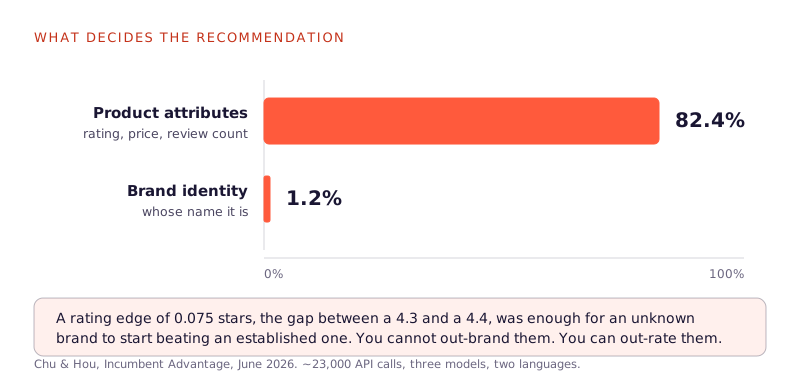
Brand is the tiebreaker when nothing else distinguishes you. It is not the deciding factor when something does. You are never going to out-brand a national chain, because their name was in the training data and yours wasn't. You can absolutely out-rate them, and the research says that is the lever that moves.
In the valley this is very winnable. A dentist in Palm Desert with 180 real reviews and specific current answers is in a genuinely better position than a national brand with a generic page. That was not true in the ten blue links era.
What this adds up to
Four claims, four different verdicts. There is no secret system, and the company that builds it says so in public. The clicks really are down, measured properly. The bleeding really did slow this year. And the thing that decides whether an AI recommends you is overwhelmingly your ratings and your specifics, not the size of your name.
None of that requires panic and none of it justifies ignoring the whole thing. It requires the same unglamorous work it always did: answer the questions your customers actually ask, in plain language, on a site machines can read, with reviews that back you up, and check monthly whether the AI tools name you.
The businesses that get this right aren't the ones with the best theory about AI. They're the ones who read the research instead of the screenshot.
Questions about the research
How do I check a statistic somebody sends me? Ask four things: who ran it, when, on how large a sample, and whether they sell something the answer conveniently supports. If the article doesn't link the original study, that absence is usually your answer. And if you can't get to the study yourself, treat the number as a rumor, not a fact.
Why do different articles quote wildly different numbers for the same thing? Because they measure different things and rarely say which. Share of queries showing an Overview, click-through rate on those queries, and total clicks are three separate measures that move independently. Seer found impressions doubling while clicks stayed flat, which can be written up as a catastrophe or a wash depending on what the writer wants you to conclude.
Should I read the limitations section of a study? It's often the most honest part. Chu and Hou tested mostly skincare products and three closed models, and said so plainly. That doesn't invalidate the finding, it tells you how far to extend it. A study that lists no limitations has usually been written by a marketing department.
Is any of this different for a small local business? Yes, in your favor on one count. Most of this research uses national consumer brands competing on the same product. Local intent is narrower, the competitor set is smaller, and Google Business Profile data carries real weight. The incumbency problem is smaller at valley scale than the headline numbers suggest.