
Saffron Restaurant & Lounge
A site Google was told to ignore, indexed within days of the rebuild
engagement
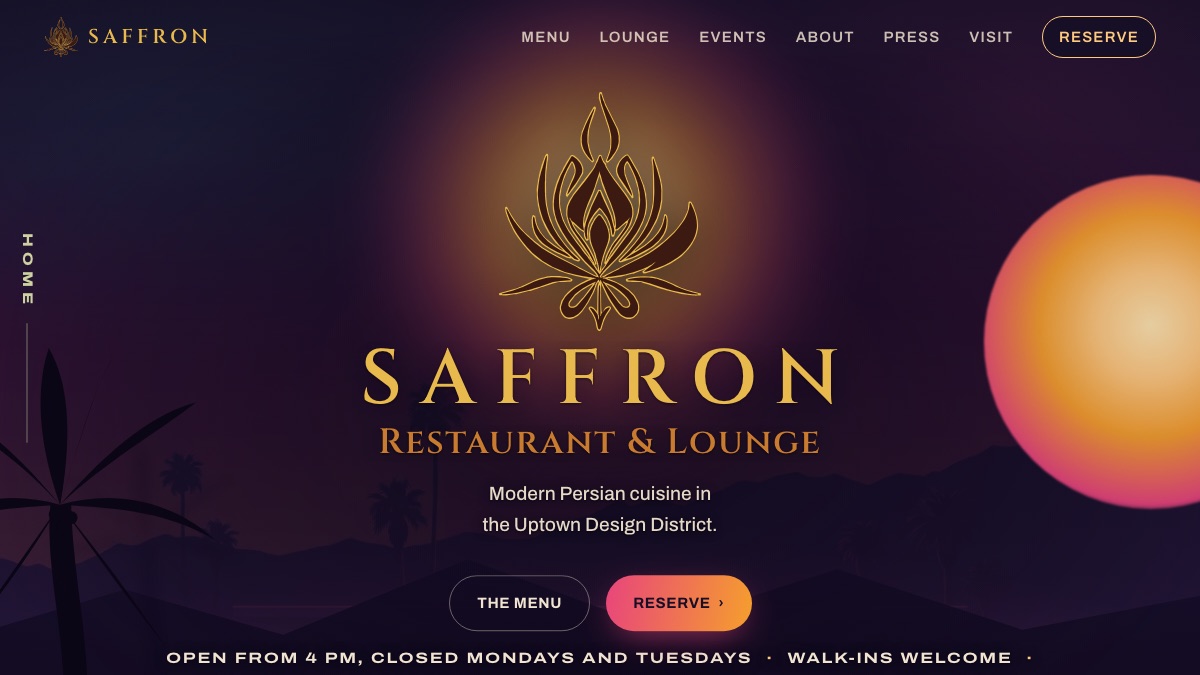
The challenge
Saffron Restaurant & Lounge serves modern Persian food on North Palm Canyon Drive, in the Uptown Design District of Palm Springs. It has an OpenTable award for visitor experience and a dining room people drive out from the whole valley for. What it did not have was a website that let anyone find it.
The old site was built on Wix, and every page in it carried <meta name="robots" content="noindex">. That tag is an instruction to search engines to leave the page out of the index, and Google obeyed it: a site:saffronps.com search returned nothing from the domain. Searching for the restaurant by name returned Yelp, OpenTable, Tripadvisor and the visitors bureau, all ranking with the restaurant's own information, on pages the restaurant does not control. The sitemap the robots file advertised returned a 404. Two pages still carried the Wix template's name in the title, so they read "About | Lawrence" and "Contact | Lawrence". The structured data listed hours that contradicted the hours on the site, and the hours on every listing. Not one of the five pages had a meta description. We scored it at 33 out of 100.
Underneath the search problem was a legal one. We ran a WCAG 2.1 AA review, because a restaurant with a dining room is squarely covered by the ADA, and in California any ADA violation is automatically an Unruh Act violation with statutory damages attached. We confirmed 17 issues by hand: 5 critical, 7 high, 4 medium, 1 low. The worst of them was the navigation. The "More" menu opened on hover only, so a visitor using a keyboard or a screen reader could not reach the Contact page or the Menus page from the navigation at all.
The road
We told them what was real first. Automated scanners reported 255 contrast errors across the five pages. We re-measured every one in a live browser, and 122 of them, all on the menu page, were false alarms caused by the menu app styling itself late during the scan. The real menu text measures about 18:1. We reported the 17 we could stand behind, because a client who pays to fix problems that do not exist has been sold a report, not a repair.
Then we rebuilt the site instead of patching it. Ten pages of hand-written HTML with no build step, deployed on Vercel: home, menu, happy hour, events, about, press, reservations, an accessibility statement, a privacy page and a real error page. Fonts self-hosted, so the site loads no third-party font service and the content security policy does not have to allow one. Every photograph ships in AVIF and WebP alongside the JPEG, and stylesheets and scripts are fingerprinted so a browser can cache them for a year and still get the new one the moment it changes.
Accessibility went into the build rather than on top of it. Real headings in order, one H1 per page, images described rather than named after the camera file, everything reachable and operable from a keyboard, and a menu that is text on a page rather than a picture of a menu. The consent banner gives Decline the same size and weight as Accept, and analytics does not load at all until somebody agrees.
The foundations Google and the assistants read. A schema graph tying the restaurant to its menus, its opening hours, its awards and its Google Maps listing, with a WebPage node and a real modified date on every indexed page. A sitemap, a robots file and an llms.txt. The events page is regenerated from the restaurant's Google Calendar by a scheduled job, and the job is written to fail loudly rather than let the page keep advertising a night that has already passed.
The found
The cutover happened on 2 September 2026. Three days later, every page we inspected came back from Google as "Submitted and indexed", including the events page. We rescored the site at about 92 out of 100.
The first day of Search Console data showed the restaurant at position 1.0 for "saffron palm springs" and "saffron restaurant palm springs", and on page one for "persian food palm springs". That is one day of data, not a trend, and we are not going to dress it up as one. What it does establish is that the site is now in the index and that the brand searches land on the restaurant rather than on an aggregator.
The interesting number is a different one. Thirteen non-brand searches, the ones that read like "persian kabob near me" and "mediterranean restaurant palm springs", are already showing the site at positions four through eleven, and nobody is clicking yet. Google is testing this restaurant against category demand for the first time. That is the next stretch of road, and it is a much better problem than being invisible.